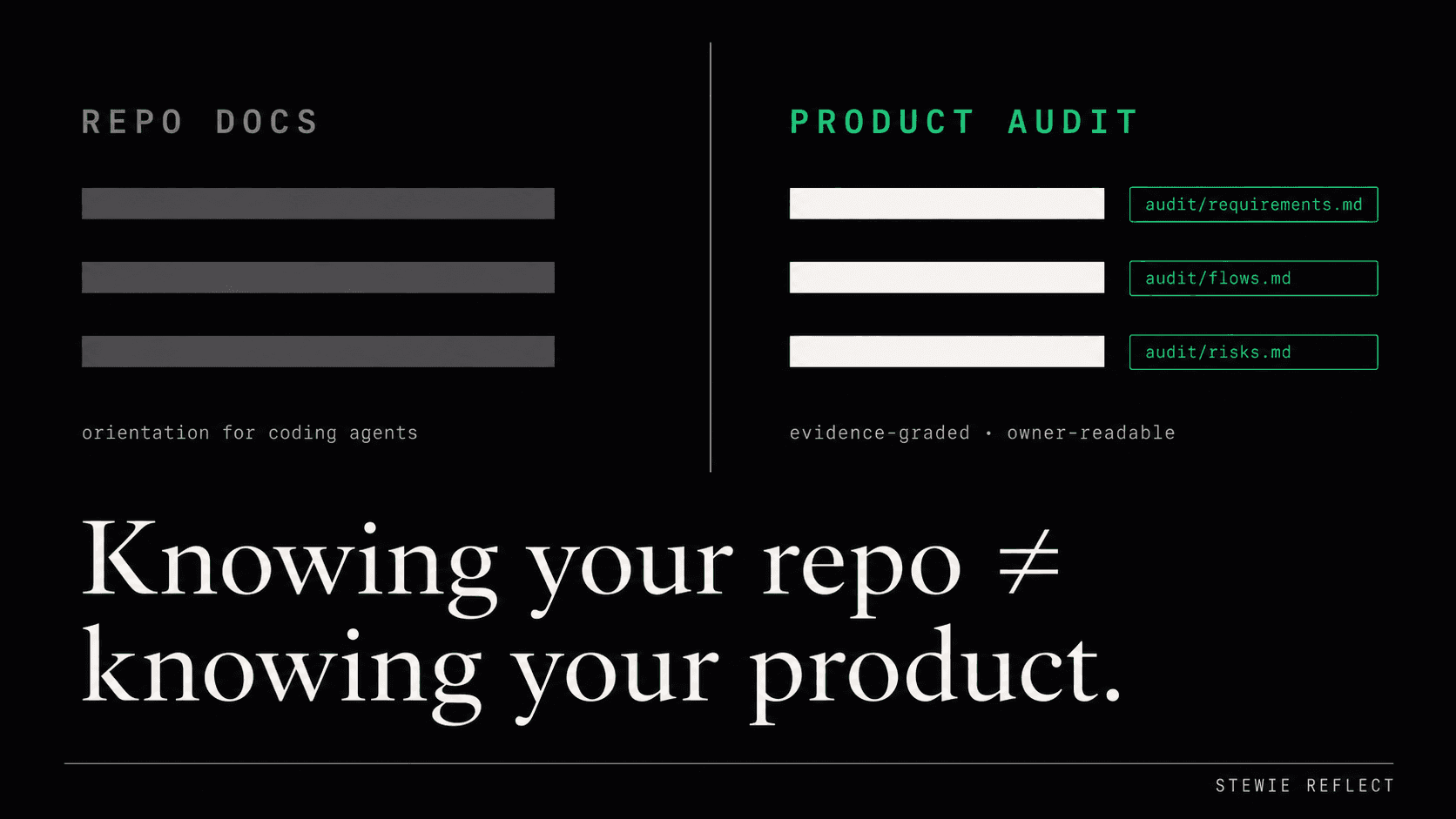
LangChain released OpenWiki, an open-source CLI for generating and maintaining repo documentation for coding agents.
I don't read that as bad news for Stewie Reflect. I read it as category validation.
And it is a signal with real weight: OpenWiki picked up roughly 1,900 GitHub stars within two weeks of release. This is not a throwaway launch post — the market clearly wants maintained repo context.
If LangChain is shipping a repo wiki agent, the need is real: agents need durable context about the codebases they work in. They need to know where key logic lives, how files connect, and which patterns the repo expects. A single AGENTS.md or CLAUDE.md file cannot carry the whole mental model of a serious codebase.
That is the right problem to name.
It is also not the whole problem.
Repo documentation helps an agent orient itself in code. Product understanding helps an owner decide what the product actually does, what is known, what is inferred, what is risky, and what deserves human validation before the next change.
Those are different jobs.
What OpenWiki is good at
OpenWiki is built for codebase documentation. It installs as a CLI, writes documentation into an openwiki/ directory, and updates top-level agent instruction files like AGENTS.md or CLAUDE.md with a reference to the generated wiki. That is a sensible design choice: don't cram a whole repo wiki into the instruction file; point the agent at the context and let it retrieve what it needs.
It also tackles the maintenance problem. The repo describes openwiki --init for initial generation, openwiki --update for keeping docs current, and a GitHub Action path that can open a PR with documentation updates. LangChain's launch post says update runs use git diffs since the previous run, then refresh the wiki with relevant context.
That loop matters. The hard part of docs is not writing the first version. The hard part is making the second, third, and twentieth versions stay true after code changes.
For coding agents, a maintained repo wiki is useful. It can answer questions like:
- Where does auth live?
- Which package owns billing?
- How do services call each other?
- What conventions should the agent follow before editing this area?
- Which docs should the agent read before touching a subsystem?
That is repo orientation. It is valuable.
Where repo wikis stop
A repo wiki can tell an agent where the auth code lives. It does not necessarily tell the owner whether the auth behavior is safe, risky, inferred, unknown, or intentionally unfinished.
That distinction is where the category gets interesting.
To be fair about what OpenWiki generates: this is not ungrounded prose. Its agent prompt explicitly tells the model not to invent facts, to ground important claims in source files, existing docs, or git history — and to capture business and product logic, not just file structure. That is more discipline than most generated documentation gets.
But grounded documentation is still documentation. It can be accurate, well-sourced, and still not answer the question an owner actually has — because the reader cannot see, claim by claim, what is confirmed, what is inferred from implementation, and what nobody has validated yet.
For example:
- Does a lapsed subscriber lose access immediately, or at period end?
- Is the 24-hour refund window a product decision, a placeholder, or an old default?
- Can a workspace admin remove the billing owner?
- Does this fallback hide an error the owner actually needs to see?
- Which behavior changed when the entitlement file changed?
A strong repo wiki does more than point at files — it can summarize architecture, workflows, and even business logic grounded in the code. But its primary artifact is maintained repo documentation. It is not an owner-reviewed statement of what the product now commits to.
The owner needs a different altitude: behavior, evidence, risk, and judgment.
Orientation is not validation
This is the trap with any generated documentation layer. It can feel like understanding because the output is clear.
But clear prose is not the same as validated product truth. The missing layer is not grounding — OpenWiki grounds what it writes. The missing layer is grading and sign-off: which claims a human owner has actually confirmed, and which are still the model's best reading of the code.
If a generated wiki says the subscription module "handles plan changes," that may be accurate and still not enough. The risky questions live below the summary:
- What exactly happens on upgrade?
- What exactly happens on downgrade?
- What happens mid-cycle?
- Which files prove it?
- Which part is inferred from implementation rather than confirmed by a person?
- What changed since the last time we looked?
For a coding agent, "this is the subscription module" may be enough context to start editing. For a founder, acquirer, operator, or product owner on the hook for the product, it is only the beginning.
The product question is not "where is the code?"
The product question is "what does the product do, what evidence backs that, what should I worry about, and what do I need to decide before changing it?"
What Stewie Reflect is trying to be
Stewie Reflect is not trying to be a repo wiki.
Stewie Reflect reads a repo snapshot and generates an owner's manual for the product inside it: behaviors in plain language, grouped by what they are for, with claims tied back to the files and functions that support them.
The point is not to help an agent find the right directory faster. That can be useful, but it is not the main wedge. The point is to help a human owner understand the product well enough to speak for it.
That means the manual has to do different work:
- Separate what appears known from what is inferred or missing.
- Link claims to evidence so the reader can verify instead of trust.
- Surface risky areas like billing, auth, permissions, data handling, and integration boundaries.
- Name gaps honestly instead of smoothing them into confident prose.
- Give the owner a readable artifact they can export, share, and revisit outside an agent session.
That last part matters. "Ask the agent to explain the repo" is useful for a moment. But if the answer vanishes when the session closes, cannot be audited, and has no stable relationship to the next snapshot, the owner is still rebuilding understanding over and over.
Reflect's bet is that understanding needs to become an artifact.
When to use OpenWiki vs Stewie Reflect
Use OpenWiki when your coding agents — and the developers working alongside them — need durable repo orientation.
That is its design center: codebase docs maintained from changes, referenced from the instruction files agents already read, and readable by humans too.
Use Stewie Reflect when a founder, operator, acquirer, product owner, or technical lead needs to understand what the product does before touching risky behavior.
That is a different fit: an evidence-linked manual for humans who need to decide whether they trust what they own.
Use both if you want both layers:
| Need | Better fit |
|---|---|
| Help coding agents navigate repo structure | OpenWiki |
| Maintain codebase documentation for agents | OpenWiki |
| Understand what a product does in product terms | Stewie Reflect |
| Audit risky behavior before changing it | Stewie Reflect |
| Give a non-technical owner a readable manual | Stewie Reflect |
| Keep agent instructions lightweight while pointing to repo context | OpenWiki |
| Preserve product understanding outside an agent session | Stewie Reflect |
This is not a winner-takes-all category. It is a stack.
The repo wiki helps agents work inside the codebase. The owner's manual helps humans understand the product the codebase implements.
The next loop is scan, change, rescan
The most interesting part of OpenWiki is not that it generates docs once. It is the update loop.
Generate the wiki. Change the code. Run the update — scoped by git diffs to what actually changed. Open a PR with only the docs that need updating. Nothing changed, no PR.
That is exactly the kind of loop product understanding needs next, at a different altitude.
Not:
generate documentation once
But:
scan snapshot A -> change code -> scan snapshot B -> compare what changed in product behavior, evidence, risks, and unknowns
That comparison is where the owner gets leverage.
If the auth module changes, a repo wiki can update the auth docs. Good.
But the product owner also needs to know:
- Did a confirmed behavior change?
- Did a new risky path appear?
- Did a previously unknown gap get resolved?
- Did evidence for a claim disappear?
- Did a harmless-looking refactor change what a user can do?
That is not just "keep documentation up to date." It is "keep product understanding up to date."
OpenWiki is a useful signal because it shows the market is moving toward maintained context, not one-off summaries. Reflect should apply that same lesson to product behavior and owner judgment.
The category is becoming real
LangChain shipping OpenWiki is a signal that "repo documentation for coding agents" is becoming a real category.
That is good. It means the market is learning that agents need durable context outside the prompt window.
But if you own the product, repo orientation is not enough. You need to know what the product does, what the code proves, where the evidence is thin, and which decisions are still yours to make.
That is the layer Reflect is aiming at.
If you vibe-coded or inherited a product and are about to touch billing, auth, permissions, data, or any risky flow, run Reflect first and see what it thinks the product does.
Then read the evidence before you change the behavior.
Disclosure: Stewie Reflect is not affiliated with LangChain or OpenWiki. OpenWiki is an open-source project from LangChain; Reflect is a Stewie product built around evidence-linked product understanding.