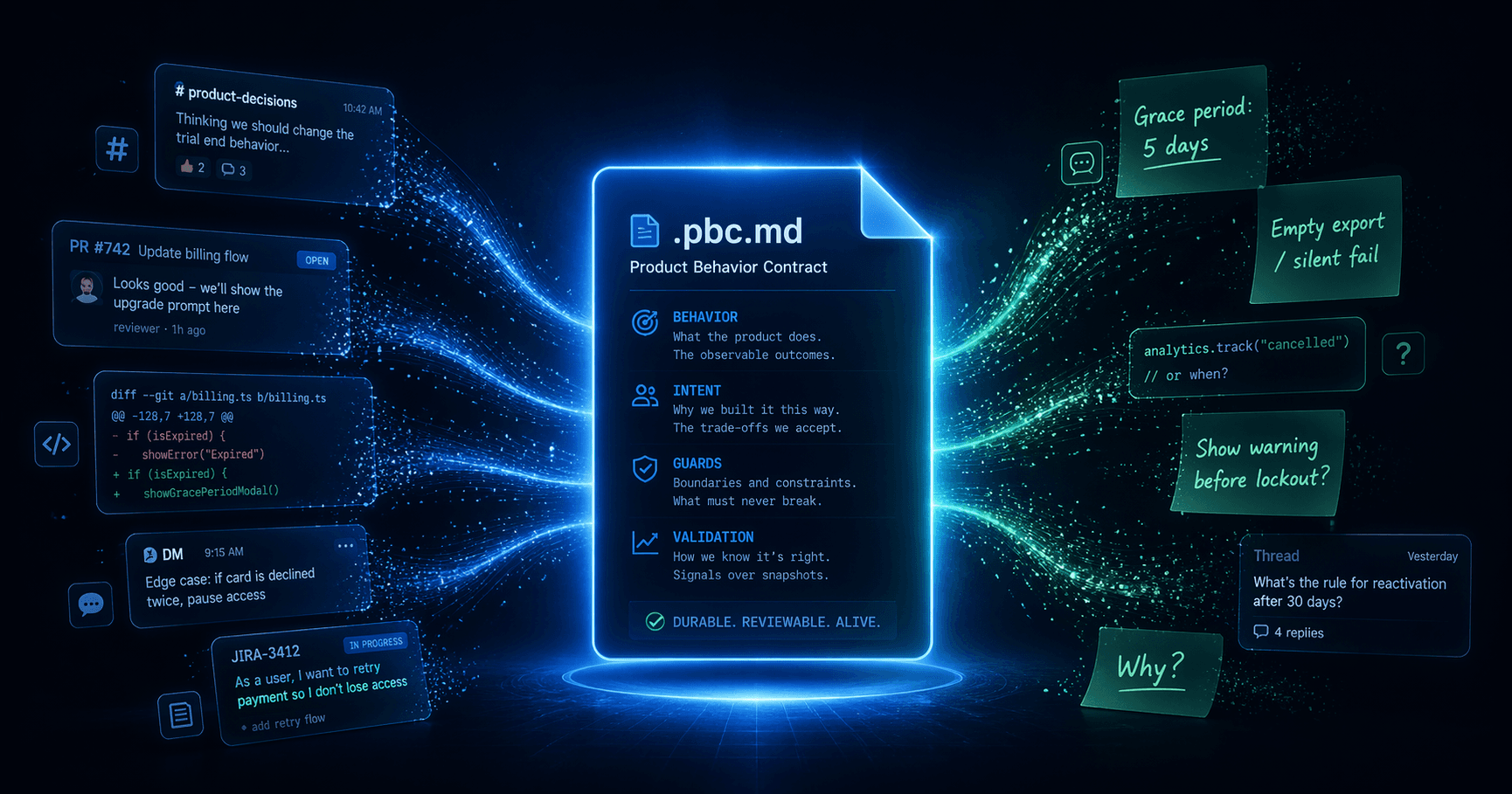
TL;DR: “Product engineer” is a label for a real shift: more engineers own customer outcomes end-to-end. As that happens (and as AI makes shipping faster), the bottleneck becomes product truth — keeping intent aligned with what production actually does. The missing artifact is a living behavior contract: not docs, not tickets, not tests.
The “product engineer” conversation tends to sound like a job-title debate.
It’s not.
It’s a signal that the center of gravity is moving: more engineers are being asked to own outcomes, not just deliverables.
And if that becomes normal, most teams will hit the same wall:
You can ship faster than you can remember what your product is supposed to do.
“Product engineer” is a messy label for a clear pattern
Depending on the company, “product engineer” can mean:
- a full-stack generalist who ships end-to-end
- an engineer with strong UX taste and ownership
- an engineer who can define a small slice of work without a full PRD
It’s also a long-standing title in hardware/manufacturing, which adds confusion.
But in software, the pattern is consistent: tighter loops, fewer handoffs, more individual responsibility.
That’s a good thing. It’s also how product truth gets lost.
When more engineers own outcomes, product truth fractures
As ownership spreads across more people and faster cycles, your product decisions start living in places that don’t survive: Slack threads, pull request descriptions, “tribal knowledge” in someone’s head, ticket comments that never get read again.
The code will reflect something. But the why disappears, and the “what” becomes ambiguous:
- Is the 14-day refund window a deliberate product rule, or just the current implementation?
- Is “3 projects on free tier” a hard cap, or a soft warning?
- Is this edge case intentionally allowed, or simply not handled yet?
When you’re shipping quickly, these aren’t philosophical questions. They’re the difference between “we shipped the plan” and “we shipped a version of it.”
Here’s the shape of it in practice. An engineer is implementing a new “team” tier for billing. They look at the current code: a 14-day grace period exists for the existing tiers. They follow the pattern. They ship. Two weeks later, customer support escalates: a team-tier customer was charged at the end of grace period because the real policy says enterprise-tier accounts get 30 days, and the team tier was supposed to inherit that treatment. Nobody told the engineer — because nobody had written it down. The PRD only covered the original launch tiers. The Slack thread where “team should match enterprise grace” was decided was four weeks old, in a channel the engineer wasn’t in.
The agent that helped the engineer ship that code did exactly what was asked. The engineer did exactly what they saw. The product decision was real. It just lived nowhere that survived contact with the work.
AI makes the problem sharper, not softer
If your team’s execution speed increases (because of AI, better tooling, or smaller teams), the cost of missing product truth goes up: more changes per week, more surface area touched per change, more chances to refactor away an implicit business rule.
A small team running with AI agents will refactor more in a quarter than a five-person team did in a year. Every refactor is a chance to silently change a load-bearing rule — the 14-day window, the soft-cap behavior, the edge case nobody knew was intentional. Without a durable artifact pinning down which numbers, constraints, and edge cases are decided (and not just implemented), you’re not refactoring code. You’re rewriting product decisions and not knowing which ones moved.
A stronger builder can create bigger product mistakes more efficiently — if nobody has the artifact that defines what the product must do.
The missing artifact: a living behavior contract
Most teams don’t need more process.
They need a better artifact.
Something that sits between “spec” and “implementation” and answers:
- what the software does (including edge cases)
- which behaviors are confirmed as intentional
- which behaviors are provisional and likely to change
- what’s still undecided
That artifact is what we call a Product Behavior Contract (PBC).
It’s markdown-first, readable, and can include structured anchors when precision matters.
And it’s designed to survive organizational change.
Why this isn’t docs, tickets, or tests
It’s tempting to say “we already have docs.” But docs optimize for explanation, not coverage of real behavior. Tickets optimize for coordination, not long-term truth. Tests optimize for preventing regressions, not communicating intent across humans.
A behavior contract is different: it’s a durable, reviewable statement of what the product does and what the team intends.
Where Stewie fits
Stewie is a product intelligence workspace built to make this contract practical.
The workflow is simple:
- Run product analyses on a repo to generate a product structure map and candidate behaviors.
- Triage those behaviors with the people who know the intent — keep what's right, flag what's not.
- Maintain a living
.pbc.mdcontract that stays aligned as the code evolves.
If you’re a product-minded engineer (or a PM/Eng pair) shipping quickly, that’s the missing layer:
Not “more documentation.”
Product truth that doesn’t disappear.
The format is open source. The PBC viewer lets you browse contracts in the browser. And Stewie is in early beta — the landing page has the waitlist at stewie.sh.
If you're shipping mostly with coding agents and you want the specific funnel for catching up to what they ship, there's a focused entry point at Stewie for vibe coders.